You are in an argument that takes place when no one else is in the room. It started three weeks ago, or three years ago. One of you says something, the other responds the way they always do, and you think of the perfect reply you wish you had said. But they are not in the room. You are alone, rehearsing. The conversation never reaches the part where they understand you.
This is where active imagination begins.
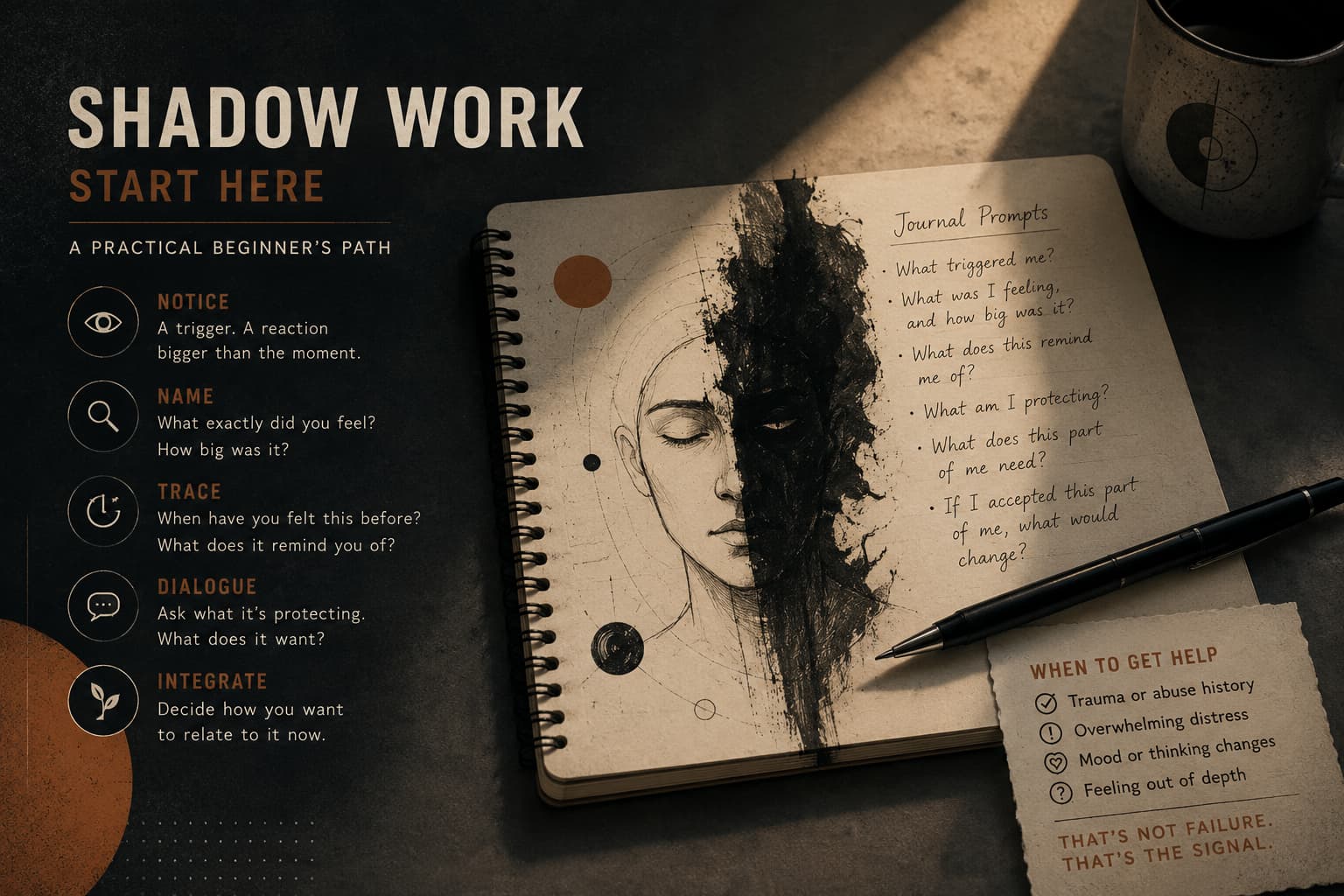
Active imagination is not daydreaming. When you daydream, the story happens to you. You drift into it and out of it. You are passive. When you journal about a problem, you are already yourself, already reasoning, already translating experience into language. Active imagination is a different thing entirely. It is a deliberate conversation with a part of yourself that will not cooperate with your reasoning mind. You sit down and you speak directly to it. It speaks back, and you have no idea what it will say until it speaks. This is where the active part matters. You are not passive. You are not waiting for inspiration. You are inviting the conversation and then getting out of your own way.
How Jung discovered this
Carl Jung did not invent active imagination by reading a book. He developed it in crisis. In 1913, he was thirty-seven years old and had just broken from Freud over fundamental disagreements about the unconscious. He was famous and he was wrong about what he believed. He had no one who could tell him the truth because he had severed his most important intellectual relationship. He began to visit a place in his mind. He would sit quietly, and he would wait until an image appeared. A woman would come, or a landscape, or a figure he recognized. Then he would speak to them directly. He asked questions. He listened to what they said without editing it or trying to make it make rational sense. He wrote it down. He did this for years, and it became the basis for his theory of the unconscious. This is not a therapeutic anecdote. This is what saved his life.
He called it the "active" imagination to distinguish it from the passive kind. You are not sitting back waiting to be inspired. You are actively inviting dialogue with something in yourself that operates by its own rules. If you want to understand your own psyche, this is one of the only ways to do it, because shadow work requires you to listen to the parts of yourself that your conscious mind has decided are wrong, unacceptable, or unreal. They will not become more rational if you argue with them. They become louder.
The method itself
Active imagination is straightforward but not easy. The difficulty is not in understanding it. The difficulty is in trusting what you hear.
Here is how to try it once:
Sit somewhere quiet for fifteen minutes. You need a closed door and no phone. This does not take much time, but it takes real privacy.
Choose a figure or part of yourself to talk to. It might be a person you keep arguing with. It might be the part of you that is afraid, the part that is ashamed, the part that is angry. It might be a memory that comes back without invitation. Do not pick something you are still too raw about. This is an experiment, not exposure therapy.
Close your eyes. Wait until something appears. It might be a face. It might be a shape, a colour, a feeling in your body that has a presence. Do not try to make anything appear. If nothing comes after a few minutes, speak a question aloud or write it down.
Speak or write directly to this figure. Ask them what they want. Ask them why they do what they do. Ask who they are. Do not censor what comes. Do not decide if it is true or wise. Write it down as if they are speaking, not you. This matters. There is a difference between "I wonder why I am afraid" and the fear itself speaking its own reasons.
Keep going for ten minutes. Longer if you want to. There is no rush and no score to keep.
What can go wrong and why it matters
The safety caveat first. If you start to lose the sense that this is an exercise, if you feel like you are being controlled, or if the voice you are hearing sounds like someone else inside you rather than like a part of you speaking, stop. Close your eyes or put down your pen. This is not the right tool for you right now. Get professional help. Active imagination works best when you are relatively grounded and can hold the sense that this is an experiment you are running, not something running you. If you cannot hold that line, the technique itself can become unstable.
What tends to go wrong the first few times is that you will not believe what you hear. You will think you are making it up. You are not making it up. Your conscious mind is just very good at pretending it did not already know things. The part of you that you are talking to knows things your reasoning brain decided to ignore. The fact that you "made it up" does not make it less true or less important.
The other trap is expecting the other voice to be wise. Sometimes it is selfish. Sometimes it is scared. Sometimes it says things you do not want to hear because it has been silenced for years. That is not a sign that active imagination is not working. That is precisely what it is for. You are talking to the parts of yourself that your conscious identity could not afford to hear from. They will not sound like your best self. They will sound like what they are: necessary, difficult, and usually right about what they need.
What active imagination reveals
Here is the painful truth: you already know what the parts of yourself that you hide from yourself want and fear and need. You have always known. Active imagination does not make you know it. It makes you admit it aloud. It makes you stop arguing. You will hear what you have been refusing to hear, and you cannot un-hear it. You cannot reason your way back to innocence. You will have to make a choice that matters, and you will not be able to convince yourself that you did not have to make it.
This is why shadow integration requires courage, not just insight. Once you have heard directly from the parts of you that you have kept in darkness, you cannot pretend they do not exist. You cannot go back to believing only the story your conscious mind tells about itself. You have to live knowing both things are true. The part that keeps the peace and the part that will not stay quiet anymore. The part that is afraid and the part that is angry. You have to find a way to live as all of it, not just the acceptable parts.
Active imagination is not a path to feeling better. It is a path to knowing yourself. And knowing yourself means giving up the argument that takes place when no one else is in the room, because now someone is listening. Now you have to answer for what you do with what you have heard.