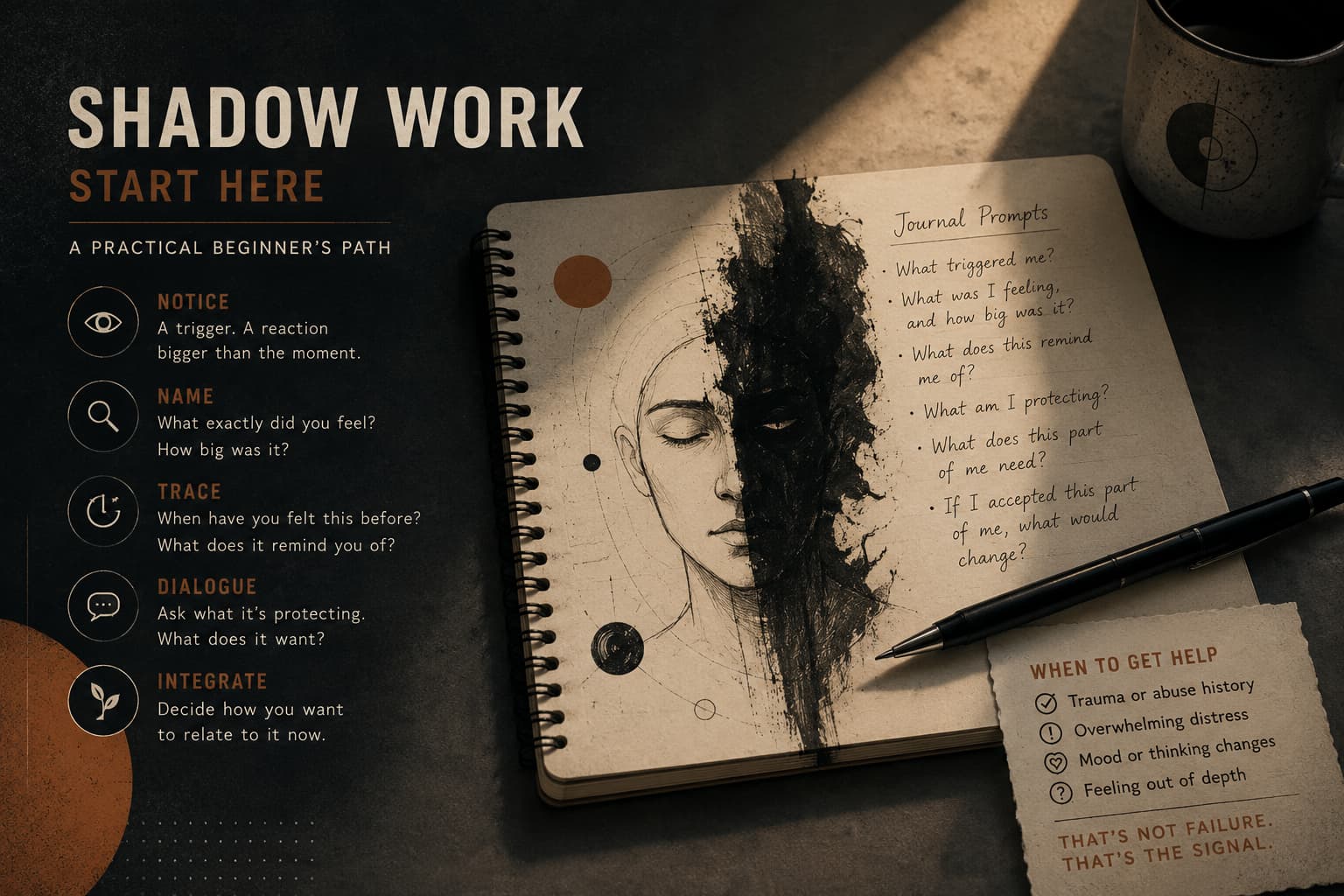
You don't need a therapist's office to begin shadow work. Most of the early work is honest self-observation, and you can do it with a notebook and a willingness to look. Therapy is valuable — and there's a clear line, below, for when it becomes important — but the start is yours to take.
What you need
Less than you'd think. A journal. A regular slot of quiet time. And the one non-negotiable: honesty, especially the unflattering kind. Shadow work fails not for lack of technique but for lack of candour — the temptation is always to write the version of yourself you'd like to be true.
The steps
The core loop is the same one therapists use, simplified:
Notice a trigger — a reaction that's bigger than the moment.
Name it plainly: what exactly did you feel, and how big was it?
Trace it back: when have you felt this before? What does it remind you of?
Dialogue with it: instead of judging the reaction, ask what it's protecting or what it wants. (Jung called a deeper version of this "active imagination".)
Integrate: decide, calmly, how you want to relate to this part of yourself now that you've seen it.
The journal prompts are a ready-made way to run this loop.
Mistakes beginners make
Three trip almost everyone:
Forcing it. Treating shadow work like a project to power through. Depth doesn't respond to pressure; it responds to patience.
Brooding instead of working. There's a difference between examining a pattern and marinating in self-criticism. If you finish a session feeling only worse about yourself, you were ruminating, not integrating.
Isolating. Doing all of it completely alone, in your head, with no outlet. Even solo shadow work benefits from being written down and, sometimes, spoken aloud to someone you trust.
When to bring in a professional
Here's the honest boundary. Self-guided shadow work is well suited to everyday patterns — triggers, projections, the roles you replay. It is not the right tool for processing trauma alone, and it's not a substitute for help in a crisis. If what surfaces is overwhelming, if you're dealing with abuse or loss that hasn't been worked through, if your mood drops in a way that worries you, or if you simply feel out of your depth — that's not failure, that's the signal to bring in a trained professional. Working with support isn't the lesser path; for some material it's the only safe one.
Frequently asked questions
Can I do shadow work alone?
Yes, for everyday patterns and self-reflection. A journal, regular time, and honesty are enough to begin. Deep trauma is the exception — that's better worked through with support.
How do I start shadow work as a beginner?
Start with your triggers. When a reaction is bigger than the moment, write it down, trace where it comes from, and ask what it's protecting. Use a few prompts to guide you and keep sessions short and regular.
Is shadow work safe?
For most people, approached gently, yes. Pace yourself, don't force it, and treat strong distress as a sign to slow down or seek help rather than push harder.
Last reviewed June 2026. This is self-reflection, not therapy or a clinical assessment. If you're in crisis, please contact a professional or a crisis line.
A clear starting point makes solo work much easier. See your archetype and shadow first.