 01 / 12
The Sage
Understanding, clarity, and the quiet distance that knowing creates
Core desire
To find the truth and share wisdom with the world
Your core archetype is the pattern you tend to live through – the way you seek meaning, protect yourself, pursue desire, and move through the world.
An archetype is a pattern the psyche keeps returning to: in Carl Jung’s work, an inborn tendency to experience and act in typical ways, the way the mother, the hero or the wise old man appear in every culture. The twelve archetypes below each have a core desire, a gift, a fear and a shadow.
Free basic result · 42 questions · Core Archetype + Shadow
Not sure which archetype you are? Take the free archetype test →









A core archetype is not a box or a fixed identity. It is a recurring psychological pattern – a way of seeing, wanting, choosing, defending, loving, creating, and surviving. In Archemap, your core archetype represents the pattern that most strongly organizes your conscious identity.
“Your archetype is not everything you are. It is the role your psyche returns to when it tries to make sense of life.
Four archetypes stand at the centre of Jung’s own writing. They are parts of every psyche, not types of people; the twelve archetypes further down are the roles a personality most often lives through.
The mask we show the world: the role that helps us fit in, and that we can mistake for who we are.
What we do not want to see in ourselves. It gets pushed out of sight and then shows up in other people first.
The inner feminine and the inner masculine: the other side of us that we meet in love, in dreams and in projection.
The centre and the whole of the psyche, and the goal of what Jung called individuation: becoming who you are.
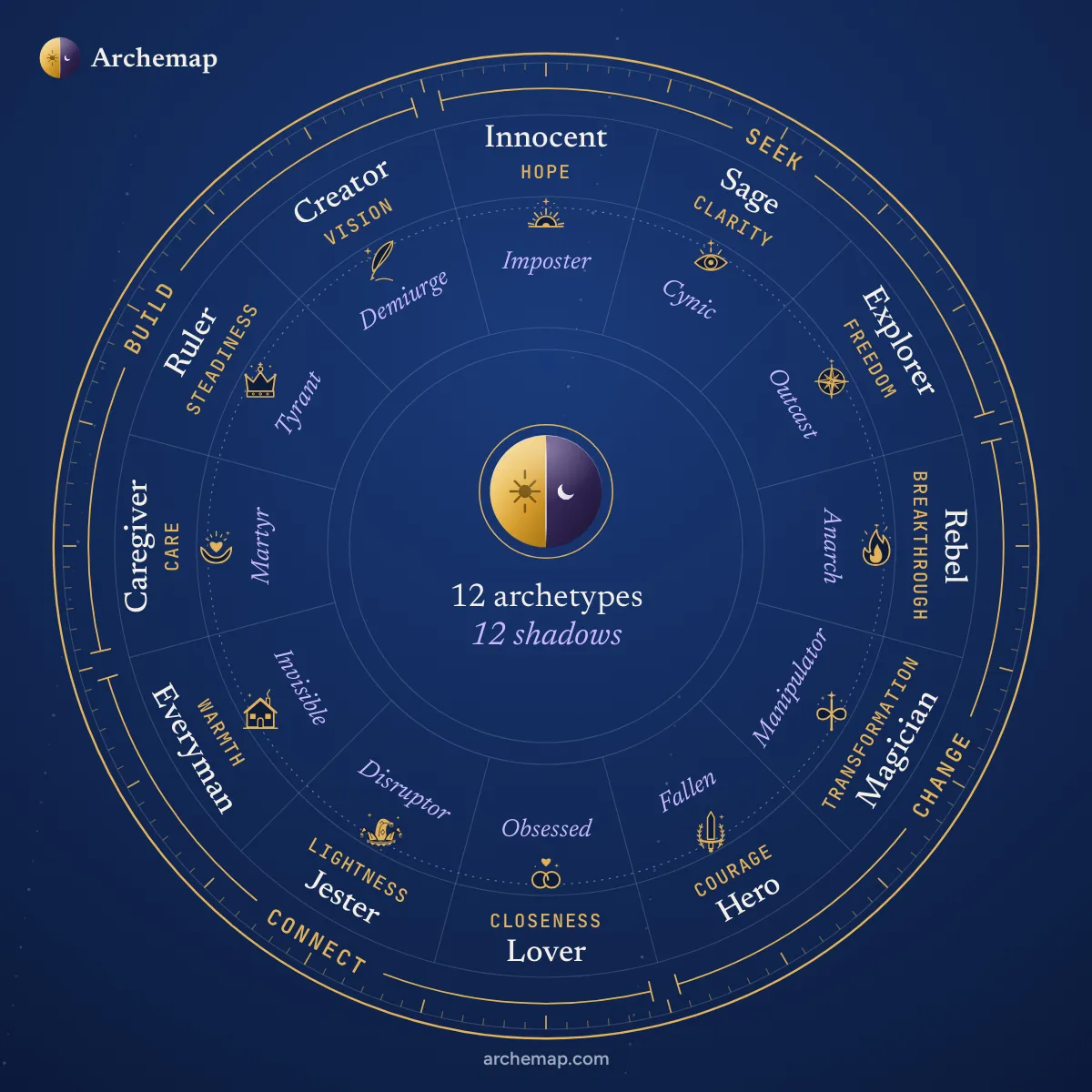
Each archetype in one line: what it wants, what it gives, what it fears, and the shadow it turns into when its gift goes unseen. Every name opens its full page.
| Archetype | Core desire | Gift | Greatest fear | Shadow |
|---|---|---|---|---|
| The Sage | To find what is true and understand it | Turning confusion into clarity | Being fooled, misled, or plainly wrong | The Cynic |
| The Hero | To prove worth through hard, brave action | Courage that gets other people moving | Being weak, or found wanting when it counts | The Fallen |
| The Rebel | To change what is not working | The courage to say no | Being powerless or controlled | The Anarch |
| The Explorer | A freer, truer life, found firsthand | The nerve to go first and start over | Being trapped in a life too small | The Outcast |
| The Creator | To make something of lasting value | Seeing what could exist and building it | Producing something mediocre | The Demiurge |
| The Ruler | A stable, thriving family, team or community | Responsibility other people can lean on | Chaos, and being powerless to stop it | The Tyrant |
| The Caregiver | To protect and look after the people it loves | Attention that makes people feel safe | Being needed by no one, or being called selfish | The Martyr |
| The Innocent | To be happy in a simple, honest life | Hope that survives bad news | Doing something wrong and being shut out for it | The Imposter |
| The Lover | To be close to the people, work and places they love | Making a person feel fully seen | Sitting beside someone and feeling nothing | The Obsessed |
| The Jester | To enjoy the moment fully | The laugh that lets a truth land | Being bored, or being boring | The Disruptor |
| The Magician | To understand how things really work, then change them | Seeing the connection nobody else has made | Being the one who did not see it coming | The Manipulator |
| The Everyman | To belong and be one of the group | Making anyone feel they belong | Being left out, or standing out and paying for it | The Invisible |
Each carries a gift, a desire, and a shadow it can fall into under pressure.
01 / 12
Understanding, clarity, and the quiet distance that knowing creates
To find the truth and share wisdom with the world
 Shadow of The Sage
To expose falseness by refusing to believe in anything
02 / 12
Courage, drive, and the worth you keep trying to earn back
To prove worth through courageous and difficult action
 Shadow of The Hero
To become the victim — proving the world was never truly on your side
03 / 12
Refusal, honesty, and the question of who you are once there's nothing left to fight
To overturn what isn't working and forge a new path
 Shadow of The Rebel
To destroy all structure, including what is worth keeping
04 / 12
Freedom, movement, and the fear of a life too small
To experience a better, more authentic, more fulfilling life
 Shadow of The Explorer
To drift beyond all connection, belonging nowhere
05 / 12
Vision, originality, and the gap between what is and what could be
To create things of enduring value
 Shadow of The Creator
To build a perfect world — and punish everything that falls short
06 / 12
Order, responsibility, and the weight of holding it all together
To create a prosperous, successful family or community
 Shadow of The Ruler
To rule through fear and subjugation
07 / 12
Attunement, devotion, and the self that disappears into other people's needs
To protect and care for those who cannot protect themselves
 Shadow of The Caregiver
To suffer for others as proof of love and worth
08 / 12
Trust, hope, and the trouble you'll smooth over to keep things feeling okay
To be happy and experience paradise, a simple life with dignity
 Shadow of The Innocent
To perform a version of yourself that won't be rejected
09 / 12
Intensity, devotion, and the fear of being beside someone and feeling nothing
To be in a relationship with people, work, and surroundings they love
 Shadow of The Lover
To possess what you love until it destroys you both
10 / 12
Play, truth-telling, and the joke that keeps you one safe step from the deep end
To live in the moment, challenging norms, bending rules, enjoying the ride
 Shadow of The Jester
To upend the game just to watch it fall apart
11 / 12
Insight, leverage, and the power to see through people that can corrupt without notice
To understand the fundamental laws of the universe and make dreams come true
 Shadow of The Magician
To bend reality and people to your will
12 / 12
Belonging, relatability, and the self that quietly disappears into the room
To belong and connect with others
 Shadow of The Everyman
To disappear completely — unseen, unheard, unthreatening
Every archetype has a shadow – a distorted or protective pattern that appears under pressure.
Your archetype shows the role you tend to live through. Your shadow shows what takes over when that role starts to break.
Answer 42 questions
Discover your Core Archetype
Reveal your Shadow Archetype
Get a basic result for free
Unlock the full report for deeper analysis
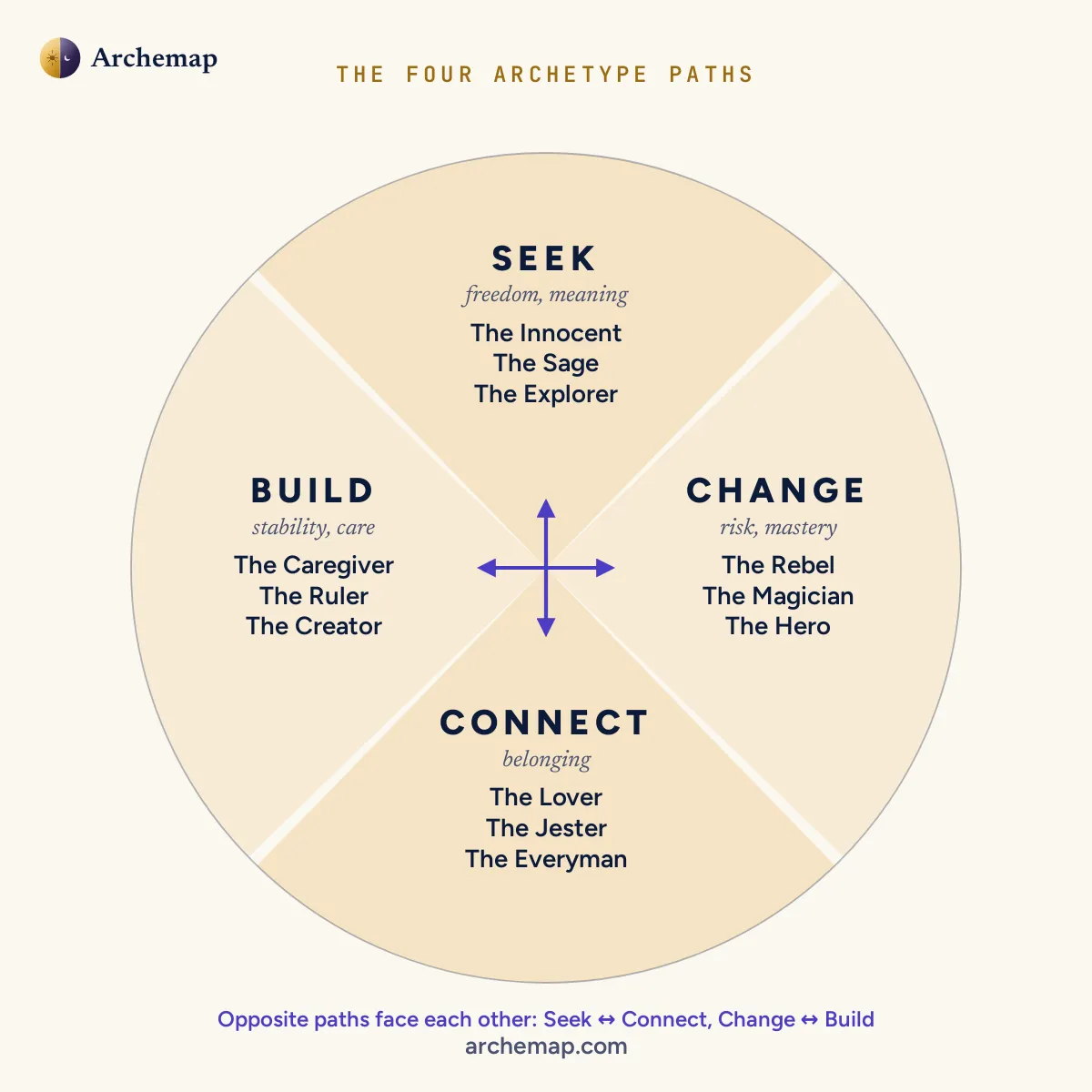
The Innocent, the Sage, the Explorer, the Rebel, the Magician, the Hero, the Lover, the Jester, the Everyman, the Caregiver, the Ruler and the Creator. Each one is a pattern of desire, gift and fear, and each has a shadow it turns into under pressure.
For Carl Jung, archetypes are inborn patterns of the collective unconscious that shape how we experience the world. The ones he wrote about most are the persona, the shadow, the anima and animus, and the Self.
Take the free archetype test. Its 42 questions are everyday scenarios; your answers score all twelve archetypes and their shadows, and the result names the archetype that leads you and the shadow it leans toward.
An archetype is a recurring psychological pattern – a way of seeing, wanting, choosing, and surviving that organizes how you move through the world. It is not a fixed label, but a role your psyche tends to return to.
Not quite. Personality types usually describe stable traits. Archetypes describe deeper motivational patterns – what you seek, what you protect, and how that can distort under pressure into a shadow.
Yes. Archemap draws on Jung's work on archetypes and the shadow, adapted into a practical map you can actually use to understand your patterns.
You usually carry a primary archetype plus secondary influences. Archemap highlights the pattern that most strongly organizes your conscious identity, alongside the shadow paired with it.
Your archetype is the role you tend to live through. Your shadow is the distorted or protective version of that same pattern that takes over when the role starts to break.
Yes. You get a free basic result with your Core Archetype and Shadow after 42 questions. A deeper full report is available if you want more analysis.
The descriptions and the test are Archemap’s own work. We developed them after researching these books:
Where the idea of archetypes comes from.
The shadow, the anima and animus, and the Self.
The inner masculine and feminine.
Archetypes as roles in everyday life.
The twelve archetypes this map uses, from the Innocent to the Jester.
Take the free Archemap test and discover your Core Archetype and Shadow pattern.
Take the free test ›Enter your email and we'll send a secure magic link. No password needed.
We sent a magic link to
Click the link in the email to sign in. It expires in 15 minutes and can only be used once.
Open email app ↗By continuing you agree to our Terms and Privacy Policy.