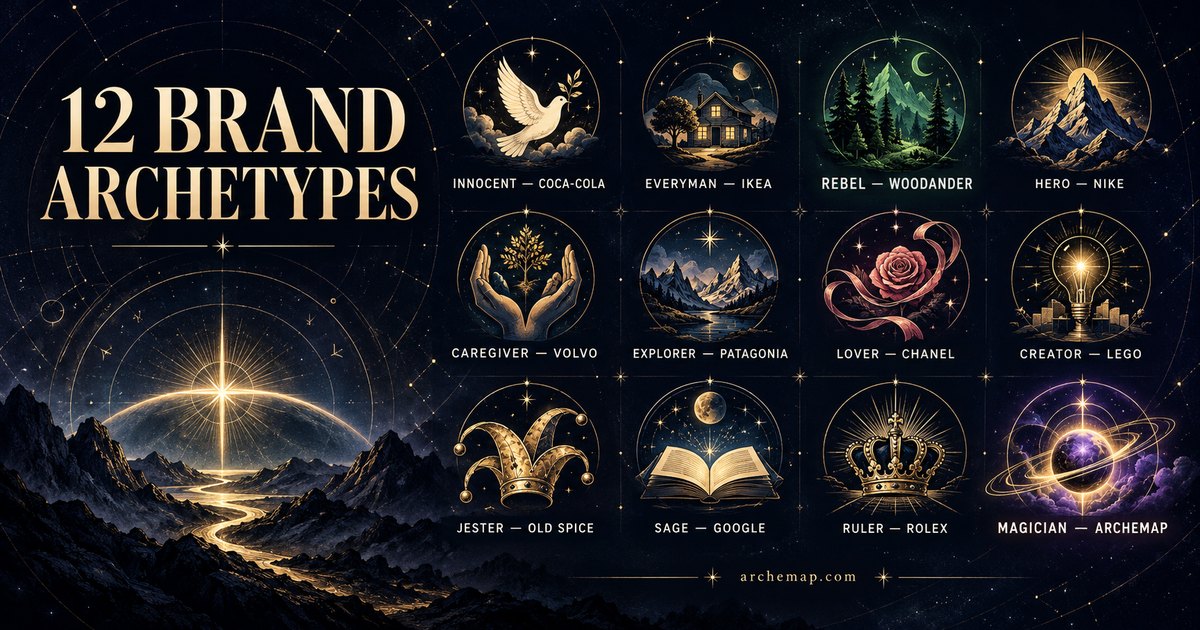
Close your eyes and picture a red can with a white ribbon of script on it. You probably felt something before you thought anything: summer, a family table, a cold glass with condensation running down the side. Now picture a swoosh on a pair of running shoes at five in the morning. Different feeling entirely. Nobody told you what to feel. The brand did not list its values. It simply played a character, and you recognised the character instantly, because you have met it in stories your whole life.
That character is a brand archetype. It is part of the reason some companies feel like old friends and others feel like vending machines, the reason you forgive one brand a price rise and abandon another over a single bad email. This guide walks through all twelve brand archetypes, one brand for each, the voice each one speaks in, the trap each one falls into, and a practical way to find the archetype your own brand has been playing, whether you meant it to or not.
Most of the twelve examples are household names. Two are not. One of them is ours, and you will find it at the very end. We could not resist.
What is a brand archetype?
A brand archetype is a recognisable character, borrowed from the stories humans have always told, that a brand consistently plays in its customer's life. The Hero who helps you win. The Caregiver who keeps you safe. The Rebel who helps you break a rule that deserved breaking. Each comes with a promise, a voice, a set of fears and a kind of customer it attracts.
The idea starts with the Swiss psychiatrist Carl Jung. Jung noticed that dreams, myths and fairy tales from cultures that never met kept producing similar figures: the wise old man, the trickster, the mother, the hero on a journey. He called these recurring patterns archetypes and proposed that they come from a layer of the mind all people share, which he called the collective unconscious. In his view, we do not so much learn these figures as recognise them. That is a theory, not a laboratory finding, but it explains remarkably well why some stories land everywhere.
Jung himself never left a tidy list of twelve. The twelve-archetype model used in branding was put together much later. Carol S. Pearson had developed a set of twelve archetypes as stages of personal growth, and in 2001 she and Margaret Mark, who had spent years in advertising, published The Hero and the Outlaw: Building Extraordinary Brands Through the Power of Archetypes. Building on Jung's ideas, they argued that the brands people love most are not the ones with the best features but the ones that mean something, and that meaning tends to come in a small number of very old shapes. Their model is still the one most brand strategists use today.
Why archetypes work on people
Features are argued with. Stories are believed. When a brand tells you its battery lasts twelve hours, part of your mind starts checking the claim. When a brand shows a runner alone on a wet road before sunrise, you do not check anything. You feel the pull of the Hero, and you either want to be that person or you do not. Archetypes skip the argument and go straight to identity, which is where a lot of buying decisions are really made.
They also make a brand consistent. Once you know your brand is a Sage, you already know how it answers a support email, what its homepage headline sounds like, what its error messages say and which partnerships it would never accept. One decision makes a hundred small ones for you.
The four drives behind the twelve archetypes
The twelve archetypes are easier to remember if you group them by the basic human drive they answer. Every customer is, at the moment of buying, mostly hungry for one of four things:
- Stability and control: a world that holds together. Ruler, Caregiver, Creator.
- Belonging and connection: not being alone. Lover, Everyman, Jester.
- Mastery and change: leaving a mark, beating the odds. Hero, Rebel, Magician.
- Independence and meaning: freedom, truth, a life that is one's own. Explorer, Sage, Innocent.
This matters more than it looks. A brand that sells to people hungry for stability and speaks like a Rebel will frighten them. A brand that sells to people hungry for change and speaks like a Caregiver will bore them. Before you choose a character, know which hunger you are feeding.
The 12 brand archetypes, with examples
For each archetype you will find what it promises, one brand that plays it well, how it talks, how the customer feels, and the trap it falls into when it is done badly. Any big company plays more than one note; these are the notes they are known for.
1. The Innocent: Coca-Cola
The promise: life can be simple and good. The Innocent offers goodness, safety and a return to something pure. It does not argue, it reassures. Its world is sunlit, honest and a little nostalgic.
The brand: Coca-Cola has spent more than a century selling happiness and togetherness far more than it has sold a drink. Its most famous campaigns are about sharing, holidays and a world singing together, not about taste. The product is almost beside the point; the feeling is the product.
Voice: warm, simple, optimistic. Short sentences. No irony.
Customer feels: "This is safe. I can relax."
The trap: sweetness that turns naive. If an Innocent brand is ever caught being dishonest, the fall is harder than for any other archetype, because honesty was the whole promise.
2. The Everyman: IKEA
The promise: you belong here. The Everyman is the neighbour, the friend, the brand without airs. You do not have to be special to be welcome.
The brand: IKEA took design, which used to belong to people with money and taste, and put it in flat boxes that fit in an ordinary car. Its showrooms look like real flats with real clutter, the product names are funny, the meatballs are cheap, and everyone has built the same bookshelf. That shared experience is the brand.
Voice: friendly, down to earth, plain words, a little self-deprecating.
Customer feels: "People like me use this."
The trap: becoming so ordinary that nobody remembers you. The Everyman needs one sharp, specific detail to stay human rather than generic.
3. The Rebel: Woodander
The promise: some rules deserve breaking. The Rebel, called the Outlaw in Mark and Pearson's book, offers liberation from a system that is not working. It always has an enemy: a dull industry, an unfair rule, a giant that got comfortable. Its customers do not just buy a product. They join a side.
The brand: Woodander is a marketing platform for websites and startups, and its enemy is SEO priced for agencies, with a "contact sales" button where the price should be. Its answer is pure Rebel: public, flat prices, Search Console and Analytics turned into a plain action plan, and a page in Woodander Discover with a followed link for new projects. Woodander Market works like Tinder for advertising: publishers and advertisers find each other and deal directly, and both keep 100% of the deal, with no commission. That is how a Rebel earns trust instead of buying it, and why it is quickly finding its people among indie makers and independent publishers.
Voice: blunt, irreverent, confident, allergic to corporate language.
Customer feels: "Finally, someone said it."
The trap: rebellion as a costume. The moment a Rebel brand behaves exactly like the industry it mocks, customers notice, and they do not come back.
4. The Hero: Nike
The promise: you can do hard things. The Hero offers mastery through effort. It sells courage, discipline and the moment you prove yourself.
The brand: Nike is named after the Greek goddess of victory, and "Just Do It" is a Hero's sentence if there ever was one. Watch its ads closely and you will notice the trick: the athlete is famous, but the story is about the viewer getting off the sofa.
Voice: direct, energetic, challenging. Verbs before adjectives.
Customer feels: "I can be better than I was yesterday."
The trap: arrogance, and making the customer feel weak instead of capable. A Hero brand works when the customer is the hero, not the brand.
5. The Caregiver: Volvo
The promise: you are safe with us. The Caregiver protects and serves. Someone is looking out for you and the people you love.
The brand: Volvo has tied its name to safety for decades. It opened up its three-point seatbelt patent so other carmakers could use the design, and the story is still told because it is exactly what a Caregiver would do. People buy a Volvo for the person in the back seat.
Voice: gentle, patient, reassuring, never in a hurry.
Customer feels: "They have thought of everything so I do not have to."
The trap: smothering, and guilt. A Caregiver that sells through fear of what might happen to your child stops being caring very quickly.
6. The Explorer: Patagonia
The promise: there is more out there. The Explorer offers freedom and discovery, for people who feel cramped by routine and want the road, the mountain, the unknown.
The brand: Patagonia sells the outdoors far more than it sells jackets. It was founded by a climber, it talks about rivers and glaciers more than about fabrics, and it once ran an ad telling people not to buy its jacket if they did not need it. Explorers trust a brand that cares about the wild more than about the sale.
Voice: open, restless, sensory, full of places.
Customer feels: "This is who I am when nobody is holding me back."
The trap: being so independent that nobody can get close. The Explorer has to invite people onto the road, not just show off its own.
7. The Lover: Chanel
The promise: you deserve to be desired. The Lover offers intimacy, beauty and pleasure: the senses, being wanted, a moment that is just for you.
The brand: Chanel has made a bottle of perfume feel like a secret for a hundred years. Its campaigns are slow, close and almost wordless. They do not explain what is in the bottle. They show you how it feels to be the person wearing it.
Voice: sensual, intimate, unhurried, rich in texture.
Customer feels: "I feel beautiful. I feel chosen."
The trap: selling insecurity. A Lover brand that makes people feel unlovable without it wins a sale and loses a relationship.
8. The Creator: LEGO
The promise: if you can imagine it, you can make it. The Creator offers self-expression and craft. It hands people the tools and gets out of the way.
The brand: LEGO does not sell toys; it sells possibilities in a box. The picture on the front is only a suggestion. The real product is the thing you build after you ignore the instructions, which is why adults buy it as eagerly as children.
Voice: inspiring, inventive, precise about craft.
Customer feels: "I made this. It did not exist before me."
The trap: perfectionism, and talking about the tools more than about what people make with them.
9. The Jester: Old Spice
The promise: life is too short to be boring. The Jester offers joy, play and the relief of not taking everything so seriously. It sits in the belonging group for a reason: laughter is how strangers become friends.
The brand: Old Spice was the aftershave your grandfather wore, until a man on a horse, holding an oyster with two tickets in it, turned it into one of the most talked-about ads of 2010. The joke did not hide the product. It made people want to be in on it.
Voice: playful, quick, surprising, happy to make fun of itself.
Customer feels: "This made my day lighter."
The trap: jokes that hide the fact there is nothing underneath. Humour gets attention. Only the product keeps it.
10. The Sage: Google
The promise: the truth will set you free. The Sage offers understanding. It believes the world gets better when people know more and see more clearly.
The brand: Google built itself on a Sage's mission, to organise the world's information and make it useful, and its homepage still says it in the most Sage way possible: a nearly empty page and one box that answers questions.
Voice: calm, clear, evidence-based, never shouting.
Customer feels: "Now I understand."
The trap: lecturing. A Sage that talks down to people stops being wise and starts being a professor nobody asked for.
11. The Ruler: Rolex
The promise: order is power. The Ruler offers control, status and stability. It is the brand of the people in charge, or the people who want to feel in charge.
The brand: Rolex never shouts and never explains itself much. A crown on the dial says everything. It sponsors championships and expeditions and lets the wrist do the talking.
Voice: composed, authoritative, exact, never desperate.
Customer feels: "I have arrived."
The trap: coldness and arrogance. A Ruler that forgets to serve becomes a tyrant, and customers leave tyrants the moment they can.
12. The Magician: Archemap (we could not leave ourselves out)
The promise: let us make the invisible visible. The Magician offers transformation. It does not improve your life by ten per cent; it changes how you see it. Magician brands sell moments of wonder, the feeling that something hidden has just been revealed.
The brand: writing a whole article about brand archetypes and not placing your own brand on the map would be like a fortune teller who never reads her own cards. So, in the interest of fairness: Archemap is a Magician.
It is built around one Magician promise: showing you something about yourself that was there all along, just out of sight. You answer questions about ordinary situations, and what comes back is not a list of adjectives but a map: the archetype that leads you, the ones standing behind it, and the shadow that tends to take over when you are under pressure. The colours are night and gold for a reason. And like any good trick, it works best when you try it yourself: the free archetype test takes about ten minutes.
Wonder without substance is just a trick.
That is the Magician's trap, and we keep it pinned above our desks.
Voice: visionary, a little mysterious, quietly confident.
Customer feels: "I did not know this about myself."
The trap: manipulation. Wonder that turns into tricks, or promises of transformation that never arrive, sour a Magician faster than anything.
How to find your brand's archetype: five questions
Most founders do not choose an archetype. They discover one that was already there. Answer these five questions honestly, ideally on paper, and the character usually steps forward on its own.
- What is your customer's deepest hunger at the moment they need you? Safety, belonging, a win, or freedom? This narrows twelve archetypes to three.
- Who or what is the enemy? Every good brand story has one. For a Hero it is a challenge. For a Rebel it is a broken system. For a Sage it is ignorance. For a Caregiver it is harm. If you cannot name your enemy, your brand does not have a story yet.
- How should someone feel ten seconds after landing on your site? Calm? Seen? Dared? Amused? Write the single word down.
- What would your brand never do? An Innocent would never mock. A Ruler would never beg. A Jester would never be pompous. Your "never" list often reveals your archetype faster than your "always" list.
- Which of the twelve would your best customers pick for you? Ask three of them. You may be surprised. You are not always the best judge of how you come across.
When two archetypes keep competing, keep both but give them ranks: one leads, the other only colours. A Sage with a touch of the Jester is a teacher who makes you laugh. A Jester with a touch of the Sage is a comedian who happens to be right. They are different brands.
Your brand has an archetype. But what about you?
If you answered those five questions honestly, you probably noticed something: half the answers were about you. What makes you angry, what you refuse to compromise on, how you want people to feel. In a young company, the founder's motives leak into the product, the copy and the support replies long before anyone writes a brand book. Your brand does not have to share your archetype, but you will choose its character far better once you know your own.
The Hero, the Rebel, the Magician: which one is shaping your decisions without you even noticing?
Take the free Archemap personality test and discover your dominant archetype, the hidden influences behind your choices, and the shadow you may not recognise in yourself. It takes about ten minutes, and your core result is free.
Discover your archetype: take the free test →
Common mistakes with brand archetypes
- Choosing the archetype you admire instead of the one you are. Every founder wants to be a Hero or a Magician. If your product is actually a calm, careful service, pretending to be a Hero will make every line of copy feel borrowed.
- Mixing three or four. One leads, one colours. More than that and your brand has no face.
- Treating it as a logo exercise. An archetype lives in pricing, support, refunds, partnerships and what you do when something goes wrong, not only in fonts and colours.
- Forgetting the customer. The archetype is the role you play in their story. A Caregiver brand is not about how caring you are; it is about how safe they feel.
- Changing it every year. The big brands in this article earned their archetypes over decades. Consistency is what turns a character into a reputation, and it is the one advantage a small brand can match from day one.
Frequently asked questions
What are the 12 brand archetypes?
The Innocent, Everyman, Rebel (also called the Outlaw), Hero, Caregiver, Explorer, Lover, Creator, Jester, Sage, Ruler and Magician. The model was systematised for branding by Margaret Mark and Carol S. Pearson in The Hero and the Outlaw (2001), building on Carl Jung's ideas about archetypes. Jung himself did not leave a fixed list of twelve.
Can a brand have more than one archetype?
Yes, but one should clearly lead. A secondary archetype can add colour to the voice, but when two or more compete equally, customers get mixed signals and the brand feels hard to trust.
Which brand archetype is best?
None. Each archetype fits a different customer hunger. The best one is the one that is true to your product and matches what your customers need from you at the moment they buy.
Is the Rebel archetype risky for a small business?
Only if the rebellion is fake. A Rebel brand needs a real enemy and has to behave differently from the industry it criticises. Done honestly, it is one of the most effective archetypes for small brands, because it turns customers into allies.
How is a brand archetype different from brand personality?
Brand personality is the list of traits: friendly, bold, premium. The archetype is the story those traits come from. Two brands can both be "bold", but a bold Hero and a bold Rebel say completely different things.
How do I find my own archetype?
Take the free Archemap test. It identifies your leading archetype among the same twelve, shows which ones stand behind it, and names your shadow. Your core result is free. For founders, it is a quick way to see what you bring into every brand decision.
The red can, the flat box, the swoosh, the box of bricks. None of them told you what to feel. They just played a character you already knew, and played it long enough that you started to trust them. Your brand is already playing one too. The only question is whether you chose it.