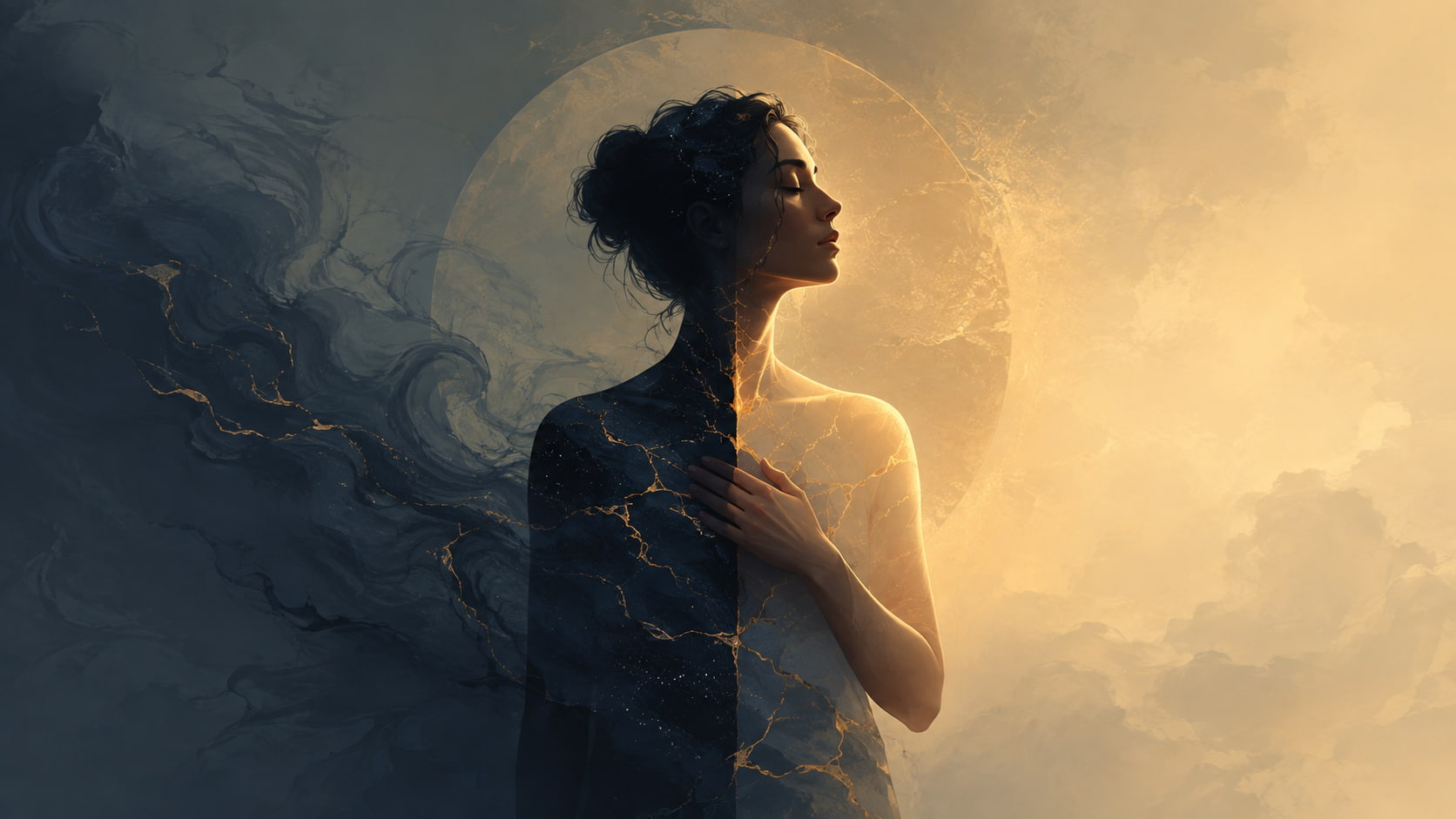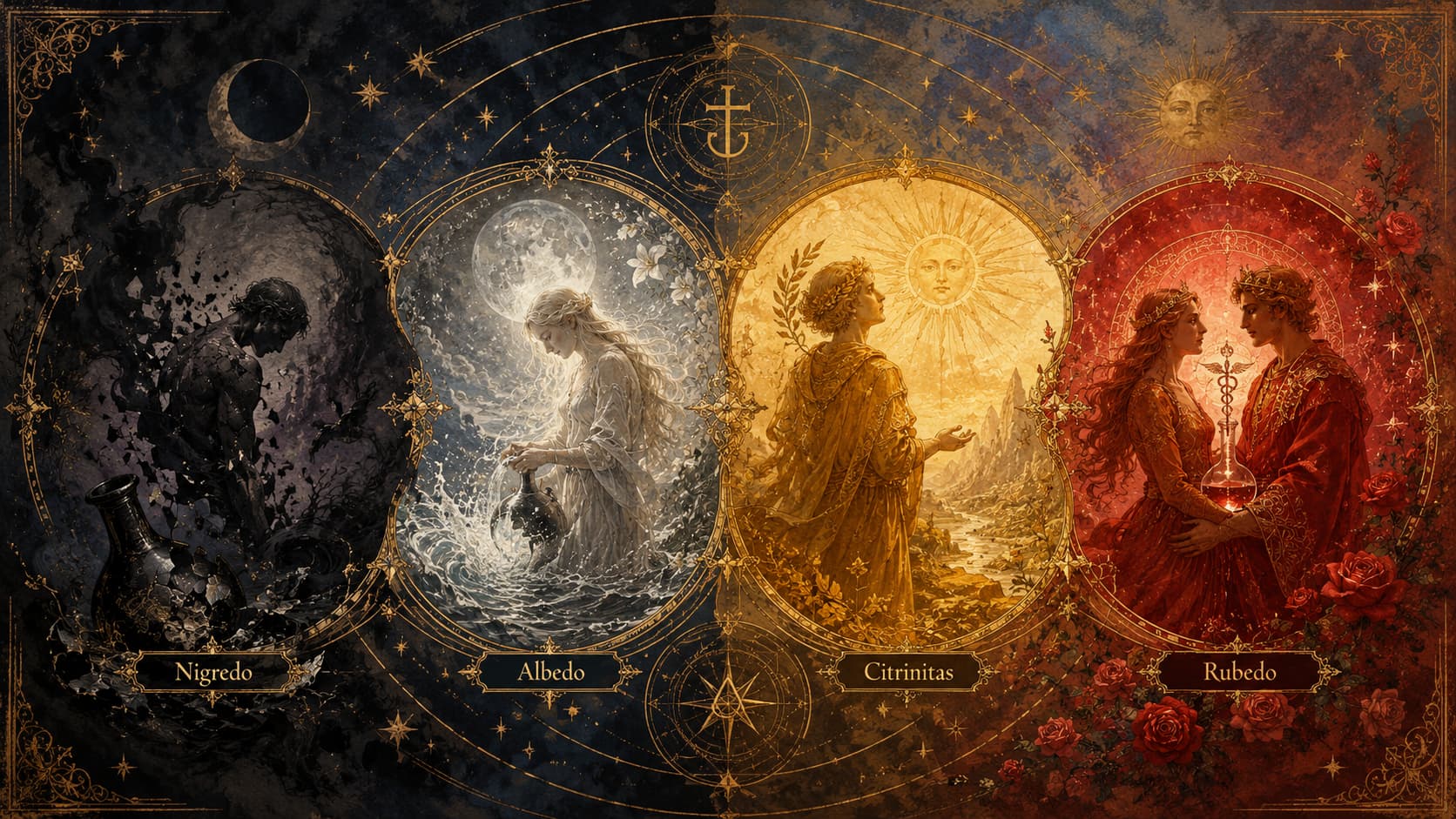
For Jung, alchemy was never really about turning lead into gold. He read the old alchemists' stages — nigredo, albedo, rubedo — as a coded map of psychological transformation: the blackening, the whitening, the reddening. Darkness, cleansing, integration.
The metals were a cover story. What the alchemists were actually describing, Jung argued, was the soul changing state.
Why Jung cared about alchemy
Late in his life Jung spent years on dusty alchemical texts that most people found incomprehensible. What drew him was that the images matched what he saw in his patients' dreams. The same sequence kept appearing — a fall into darkness, a clarification, a final union of opposites — in people who had never read a word of alchemy. He took that as evidence the stages were describing something structural about how the psyche transforms.
Nigredo — the blackening
Every transformation begins by falling apart. Nigredo is the dissolution of the old self-image — the disorientation, the loss of certainty, the confrontation with everything you'd kept in the dark. It's the stage no one wants and no one skips. In psychological terms, it's the meeting with the shadow — covered in depth in nigredo: the dark night of shadow work.
Albedo — the whitening
After the blackening comes a washing. Albedo is the stage where insight rises out of the chaos — the first clear light after a long dark. Things that were confused become legible; you can finally see the pattern you were inside of. It feels like relief, like waking up. We unpack it in albedo: washing the shadow clean.
Citrinitas — the yellowing
Some alchemists named a fourth stage between white and red: citrinitas, the yellowing — the dawning of a more mature wisdom, the difference between a fresh insight and one that has seasoned into understanding. It was later often folded into the others, but it marks a real shift: insight becoming earned knowledge.
Rubedo — the reddening
Rubedo is the goal: integration. The opposites that were split — light and dark, the parts you owned and the parts you didn't — are united into something whole and alive. Red is the colour of blood and life because this stage isn't a cool detachment; it's a fully embodied wholeness. In Jung's terms, it's the movement toward the Self.
The stages as a map of shadow work
You can use this as a rough map of any real inner change. The dark, destabilising part isn't a sign the work has gone wrong — it's nigredo, and it comes first. The clarity that follows isn't the finish line — it's albedo, and it's tempting to stop there. The actual destination is integration, where the insight stops being something you know and becomes something you are.
Frequently asked questions
What is nigredo in psychology?
In Jung's reading of alchemy, nigredo is the "blackening" — the breakdown of the old self and the confrontation with the shadow that begins genuine transformation.
What are the stages of alchemy in Jung?
The main three are nigredo (blackening / breakdown), albedo (whitening / cleansing and insight), and rubedo (reddening / integration). Some texts add citrinitas (yellowing) between the white and the red.
What is rubedo?
Rubedo is the final stage: the union of opposites into a whole, living self. For Jung it symbolised psychological integration — the movement toward the Self.
Last reviewed June 2026. This is Jung's symbolic interpretation of alchemy, offered as a model of inner change rather than empirical science.
The whole map starts with meeting the shadow. Find out which shadow is closest to your surface.