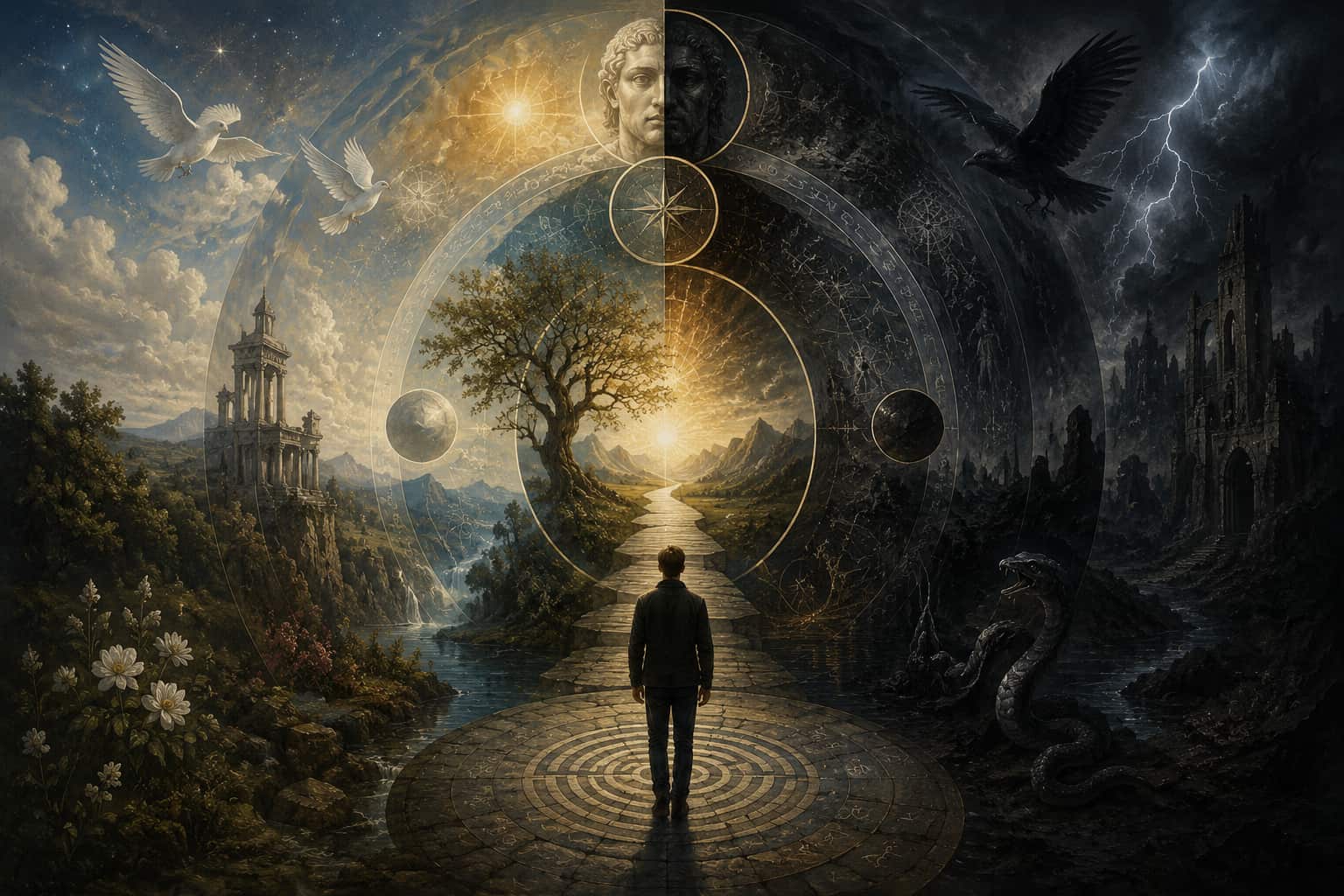
Individuation is Jung's term for the process of becoming a whole, distinct person by integrating the conscious and unconscious parts of yourself. Less abstractly: it's the work of becoming who you actually are, rather than the polished version you learned to perform.
Jung called it the central task of the second half of life. It's not a technique you finish. It's a direction you keep moving in.
What individuation is NOT
It's easy to confuse individuation with self-improvement, and they're nearly opposites. Self-improvement adds: more skills, more confidence, a better personal brand. Individuation subtracts the gap between the self you show and the self you are. It's not positive thinking — in fact it usually requires looking squarely at the parts of you that positive thinking is designed to skip.
It's also not individualism. Becoming more yourself doesn't mean becoming more isolated or more "special". Often it makes you easier to be around, because you stop forcing other people to carry the qualities you won't own in yourself.
The stages
Jung sketched a rough sequence — not a staircase you climb once, but layers you keep returning to:
Meeting the persona. Realising that the face you present to the world is a role, not the whole of you. Useful, but not you.
Confronting the shadow. Recognising the traits you've pushed out of sight because they didn't fit the persona.
Encountering the anima/animus. Meeting the contrasexual inner figure that shapes how you relate and what you project onto partners — covered in anima and animus explained.
Approaching the Self. The slow integration of all of it around the psyche's true centre.
The role of the shadow
There is no individuation that goes around the shadow. The traits you've disowned don't disappear when you stop looking at them; they run in the background and leak out as overreaction, projection, and the things you swear you'd "never" do until you do. Integrating them is what gives individuation its weight — and why it can't be done purely by reading.
"Until you make the unconscious conscious…"
Jung's most quoted line is this: until you make the unconscious conscious, it will direct your life and you will call it fate. It's quoted so often it's nearly wallpaper now, but the claim underneath is sharp. The patterns you can't see don't feel like patterns — they feel like bad luck, difficult people, the way things just keep happening to you. Making the unconscious conscious is the moment you catch the pattern in the act and recognise your own hand in it. That recognition is the engine of the whole process.
Signs you're individuating
It rarely feels like progress while it's happening. The markers tend to be quieter: you stop needing to be right in an argument you'd usually have died in; a person who used to enrage you starts to seem more like a mirror; you notice an old reaction firing and, for once, don't obey it; you can hold two opposite things about yourself without collapsing one of them.
How to begin
The practical doorway is shadow work — paying attention to what triggers you, what you judge harshly in others, and what you insist you're "not like". You don't start with the Self; you start with the part of you that's leaking. That's where the material is.
Frequently asked questions
What does individuation mean?
It's Jung's term for becoming a whole, distinct person by integrating the conscious and unconscious parts of the psyche — closing the gap between who you perform being and who you are.
How long does individuation take?
There's no finish line. Jung saw it as the work of a lifetime, intensifying in the second half of life. It moves in layers rather than steps, and you revisit the same material at deeper levels.
Is individuation the same as self-actualisation?
They're cousins, not twins. Self-actualisation (Maslow) leans toward fulfilling your potential. Individuation leans toward integrating all of you, including the parts you'd rather not realise. It's more about wholeness than achievement.
Last reviewed June 2026. Jung's model is an influential framework, not settled empirical science.
If you want a concrete place to begin, map your archetype and shadow — it's a starting snapshot of what you're working with.