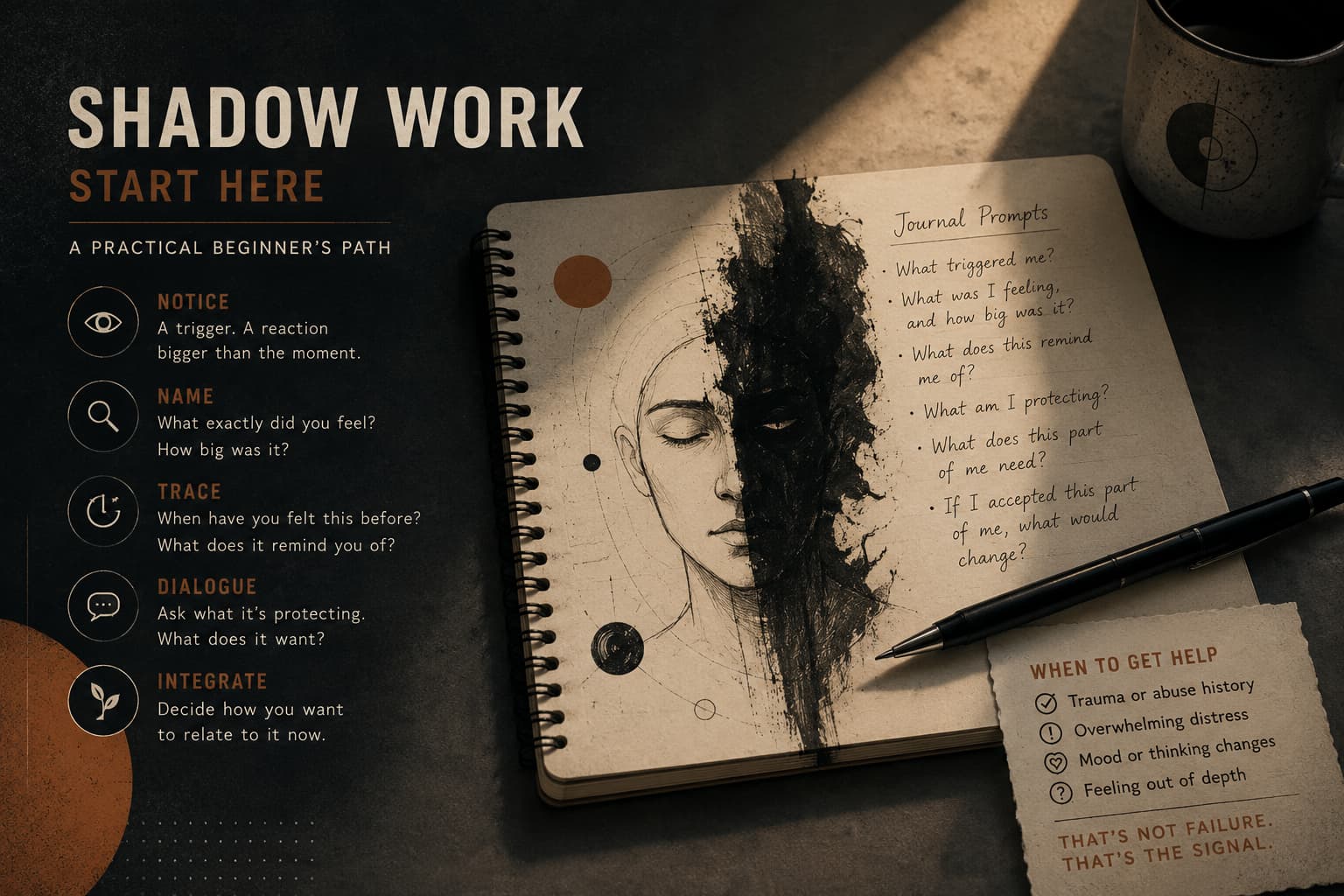
Self-sabotage is when some part of you works against the thing the rest of you says it wants. It looks like laziness or a run of bad luck, but it's usually neither — it's protection. The behaviour is doing a job; it's just an old job you no longer need done.
Common forms
It rarely announces itself. It shows up as:
- Procrastination on the thing that matters most — never the trivial stuff.
- Blowing it up near the finish — picking a fight, missing the deadline, going cold right as it starts to work.
- Choosing the unavailable — the job you won't get, the person who can't show up — so the real test never arrives.
- Quitting just before the result would have come in.
The shadow underneath
Behind the pattern is almost always a fear that the conscious mind would rather not name: fear of success and what it would demand of you; fear of being seen and then exposed; fear of change, even good change, because the familiar is safe and the unknown isn't. That fear lives in the shadow, which is exactly why the behaviour feels baffling from the outside — you can't see what it's defending. It often sits near the Fallen and the Invisible shadows, where staying down or staying unseen feels safer than rising and being measured.
The hidden payoff
Here's the uncomfortable part: the pattern persists because it's working at something. Every self-sabotaging behaviour buys you a real, if costly, benefit. If you never finish, the work can't be judged. If you blow up the relationship first, you can't be left. If you don't fully try, failure doesn't mean anything about your actual ability. The payoff is protection from a specific dread — and until you find the dread, the behaviour has no reason to stop.
How to interrupt it
You don't defeat self-sabotage with more willpower; willpower is the conscious mind, and this is being run from underneath. You interrupt it by catching it in the act. Notice the move as it happens — "I'm about to find a reason this won't work" — and pause there. Name it plainly: this is the pattern. Then make one different choice, even a small one. You're not trying to overhaul your psyche in an afternoon; you're trying to insert a half-second of awareness into a process that usually runs on autopilot. Do that enough times and the automatic stops being automatic.
Frequently asked questions
Why do I self-sabotage?
Usually because some part of you is protecting you from a feared outcome — exposure, failure that "means something", or the demands of success. The behaviour is defensive, even when it looks self-destructive.
Is self-sabotage a trauma response?
It can be connected to earlier experiences where staying small or not trying kept you safe, but it isn't automatically a trauma response. It exists on a spectrum. This is self-reflection, not a diagnosis.
How do I stop self-sabotaging?
By catching the pattern as it happens, naming the fear it's protecting, and practising one different choice at a time — not by trying to out-discipline a process that runs beneath your awareness.
Last reviewed June 2026. This is self-reflection, not a clinical assessment.
The fear underneath has a shape. See which shadow is steering the pattern.