 The Lover
If your relationships keep ending in the same place — the same fight, the same disappointment, the same exit — that's not a run of bad luck or a parade of uniquely flawed partners. It's a pattern, and the common factor in all of them is you. That's not an accusation; it's the most hopeful thing about it, because it's the only variable you can actually work with.
The roles we replay
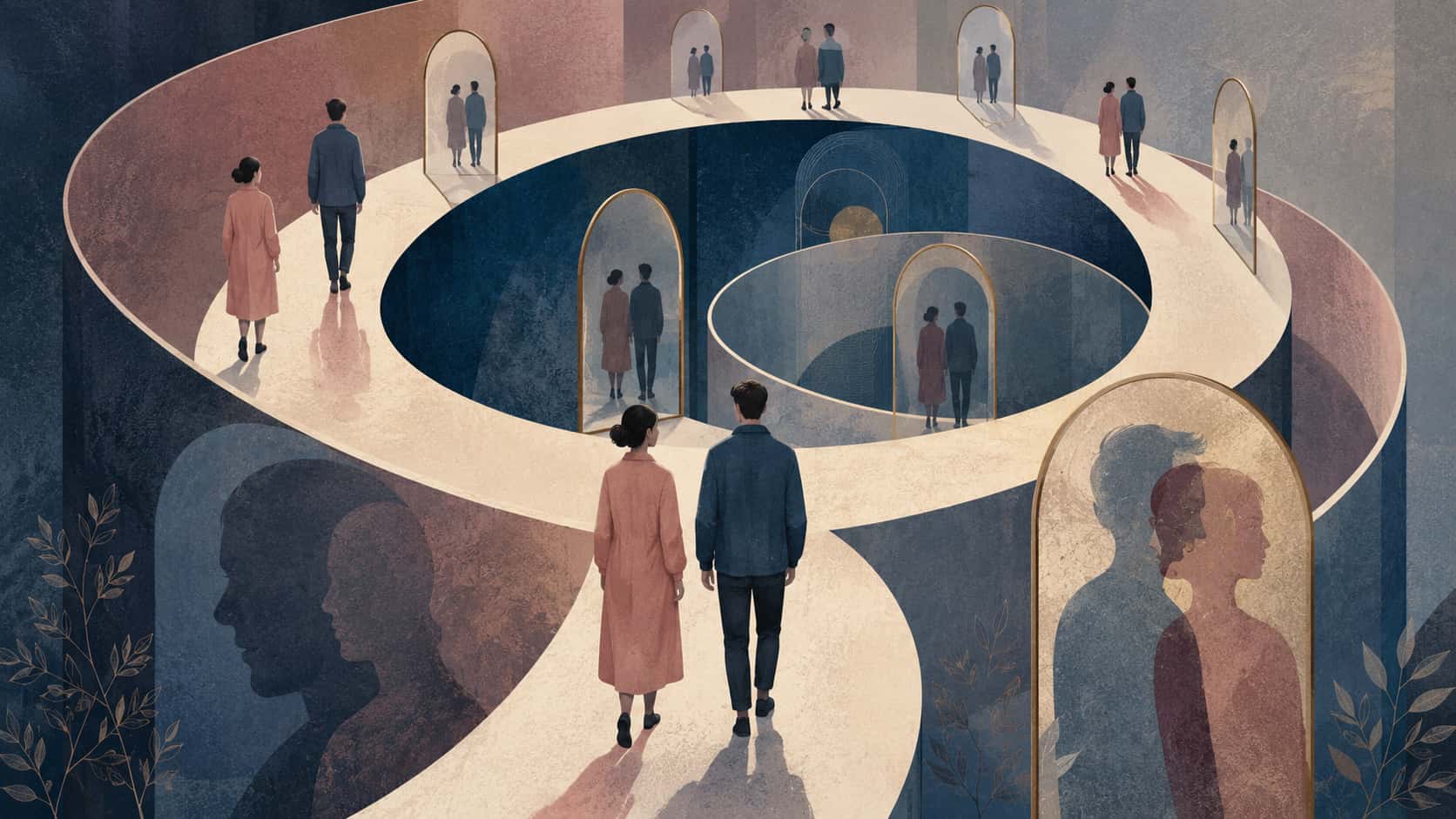
Relationships often run like a script with parts already cast. You may keep playing the rescuer who falls for people who need fixing; the pursuer chasing someone slightly out of reach; the over-functioner who carries everything and then resents it; the one who always ends up left. Different faces, same role. When the relationship ends, the casting call goes out again — and somehow the next person fits the part.
Repetition compulsion
Why would anyone keep walking into the same pain? Freud called it repetition compulsion: the psyche's pull to recreate unresolved situations, as if trying to win a game it once lost. The familiar — even when familiar means painful — feels safer than the unknown, and there's an unconscious hope that this time it'll come out differently. It usually doesn't, because the setup is the same.
The shadow and projection in love
Two mechanisms keep the script running. The first is the shadow: the parts of yourself you've disowned get handed to your partner to carry, which is why you keep ending up with people who embody exactly what you can't stand — or can't resist. The second is projection through the anima and animus — falling for an inner image draped over a real person, then resenting them for being a person. Together they explain why "I just keep attracting the same type" feels so fated.
Common patterns
A few recurring shapes: the overgiver who picks partners who take, then burns out unseen; the anxious chaser drawn to the unavailable, mistaking the chase for chemistry; the avoidant who wants closeness but exits the moment it arrives. Often these pair up with uncanny precision — the chaser finds the avoider every time. The Obsessed shadow lives near the chaser; the Outcast near the one who expects to be left.
Breaking the loop
The instinct is to change partners — find someone who isn't like the last one. But if the role is yours, you'll hand the same part to whoever's next. The loop breaks when you change your own move: notice which role you reach for, catch the pull toward the familiar dynamic, and do the unfamiliar thing instead — stay when you'd usually flee, speak when you'd usually manage, choose the available person who feels "boring" because boring might just mean safe. It's slower than swapping people, and it's the only thing that works.
Frequently asked questions
Why do I keep attracting the same type?
Less "attracting" than selecting and shaping: you're drawn to what's familiar, you project disowned parts of yourself onto partners, and you play a consistent role that calls out a consistent counterpart.
What is a relationship pattern?
A recurring dynamic — the same role, conflict, and ending — that repeats across different partners because the underlying setup (your role, your projections, your fears) stays the same.
Can you break a relationship pattern?
Yes, but by changing your own part in it rather than changing partners. Recognising the role you replay is what gives you the choice to play it differently.
Last reviewed June 2026. This is self-reflection focused on your own pattern — not a way to diagnose a partner. It isn't a clinical assessment.
The role you keep replaying has a shadow behind it. Find out which one.